
Official
Store
Store


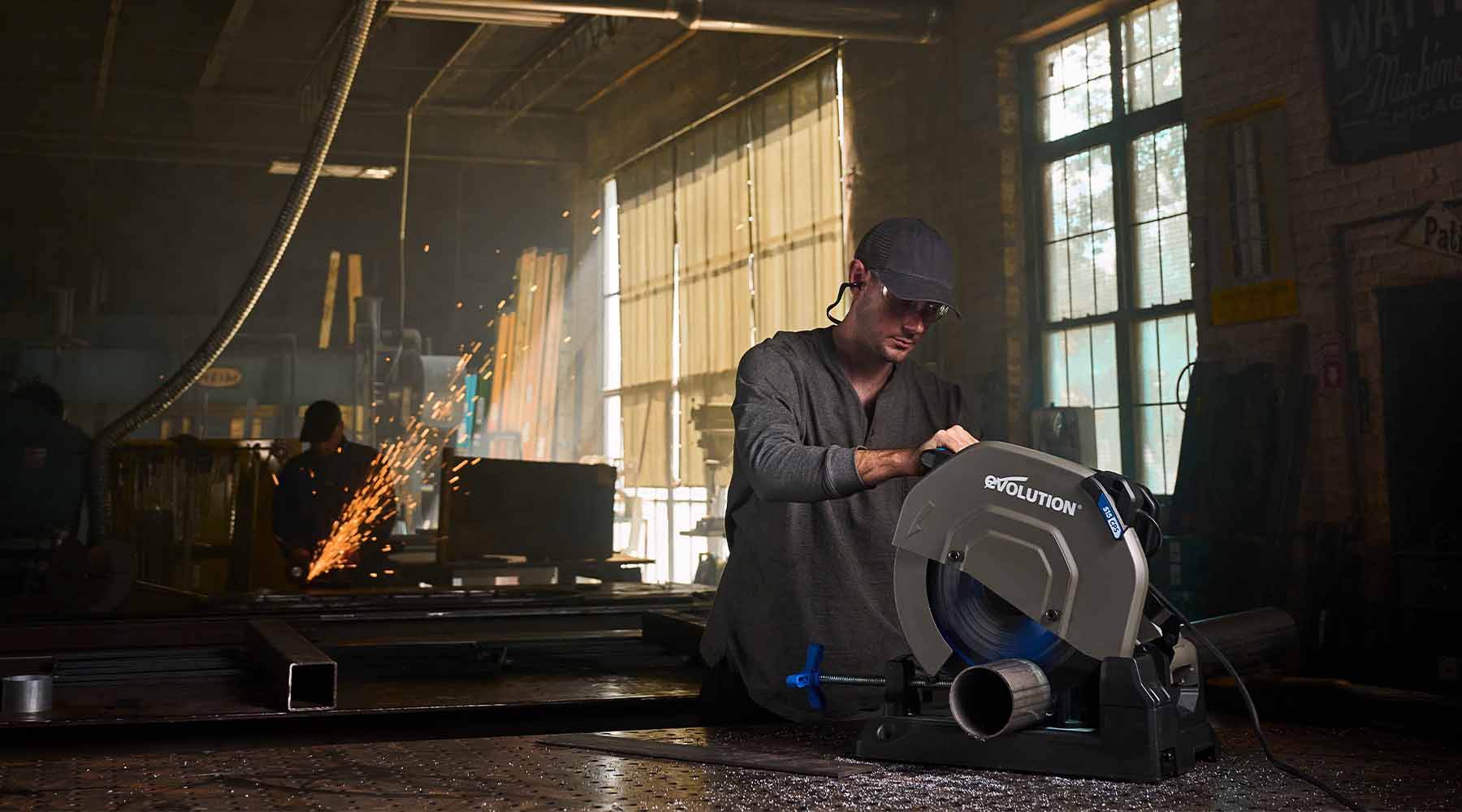
Choosing the right Chop saw shouldn’t be guesswork. Take a look at our guide on what to consider when looking for your next Chop Saw.

A chop saw is a game changer in the fabrication workshop, helping improve efficiency, provide accurate cuts and help you safely deliver high-quality craftsmanship. There are many chop saws to choose from on the market, picking the wrong one could lead to loss of time, money and materials.
Finding the right chop saw shouldn't be guesswork. We compare the best features to look for in chop saws and blades, for professionals and hobbyists alike to help you pick your perfect match.
When it comes to cutting metal, the biggest decision you’ll make is choosing between a traditional abrasive chop saw and a Tungsten Carbide-Tipped (TCT) cold-cutting chop saw. Both will get the job done, but they do it in completely different ways, with vast differences in speed, safety, and overall cost.
Here’s a quick overview of the differences:
| Feature | Cold Cutting ( TCT) | Abrasive Cutting |
| Cutting Method | Shears through the metal | Grinds through the material |
| Cutting Speed | Fast, efficient cutting | Generally slower |
| Surface Finish | Cleaner cuts with reduced burr | Often requires additional finishing |
| Heat transfer | Reduced heat transferred into the workpiece | Significant heat generation |
| Sparks | Reduced spark generation | Produces substantial sparks |
| Debris | Metal chips | Abrasive dust and debris |
| Blade/Disc wear | Maintains blade diameter | Disc diameter reduces during use |
| Cutting capacity | Remains consistent | Decreases as the disc wears |
| Tool downtime | Fewer blade changes | More frequent disc changes |
| Cost per cut | Often lower over time | Can increase through disc consumption |
It's clear that cutting metal has evolved over time, more fabricators are choosing to ditch the abrasive saws in favour of TCT for the precision, safety and durability they provide.
Learn more about the differences in our intensive guide ‘Cold Cutting vs Abrasive Cutting: Why Modern Fabricators Are Making the Switch’.

Abrasive saws use a thin, friction-based disc (a larger version of what is used on an angle grinder) that spins at a higher rate than a TCT Chop saw.
Pros: Budget-friendly option (to an extent). They are great for cutting hardened metals, rebar, or rusty scrap where you’re rough cutting and don't care about a perfect finish.
Cons: They produce a large shower of sparks, a lot of smoke, and an intense smell. Because they melt their way through metal, the cut edges are left with rough "burrs" that you’ll have to grind off later. Also, as the wheel wears down, its cutting depth decreases so if you still have large cuts to make, you’ll have to change the disc.

TCT chop saws (often called "dry cut" or "cold" saws) use a heavy-duty steel blade with tungsten carbide teeth. They spin at a much lower speeds but pack immense torque to be able to shear through metal easily.
Pros: Because they chip the metal away rather than grinding it, they generate almost no heat. You can hold the metal right after a cut without burning your hand. The cuts are perfectly clean, straight, and ready to weld immediately. One TCT blade could take you through a project as opposed to many abrasive discs.
Cons: Upfront cost is the biggest consideration when selecting a TCT blade. When you compare the durability of the TCT blade to an abrasive disc you can see that cost-per-cut makes the TCT blade much more affordable in the long run.
Cold cut blades need to be used correctly and on the appropriate materials. When not used for the materials intended or if brought down too heavily this can lead to the teeth chipping. For further advice see our cermet carbide blade guide.
For the DIY metal worker, a chop saw isn't running eight hours a day. It’s a tool that sits on a shelf until a weekend project calls, whether that's building a custom-designed piece, or cutting fence posts and railings.
If you're a hobbyist, you don't necessarily need a heavy-duty, industrial-grade chop saw. You might also not be exclusively working with metal. Instead, your choice should revolve around these key factors:
Affordability: You want a tool that pays for itself in convenience without draining your wallet.
Portability & Storage: Space is usually at a premium in modern homes, not everyone has a workshop or outbuilding. The saw needs to be easy to tuck away under a workbench and light enough to carry out to the garage or fit neatly in a shed.
Safety Features: Because you aren't using it daily, intuitive safety features are a must.
Versatility: A machine that can handle a variety of materials, from thin-walled tubing to occasional angle iron, and even wood and plastics, without complaining.
For professionals using their saw daily, a saw isn't just a tool, it can make or break your entire workflow. If your cuts are slow, inaccurate, or full of burrs, it creates a bottleneck that slows down welding, assembly, and finishing.
For high-volume shops and professional fabricators, the priority shifts entirely away from low upfront costs toward throughput, precision, and long-term cost-per-cut.
What matters most to a professional when choosing a chop saw for the workshop:
Production Speed: Seconds saved per cut add up to hours saved over the entire project.
Flawless Accuracy: Heavy-duty bases and rigid pivot arms are mandatory to prevent blade deflection and ensure dead-accurate cuts.
Ready-to-Weld Cuts: Eliminating the need to deburr or grind edges before welding dramatically increases shop efficiency, streamlines processes and eliminates a time consuming task.
Reliable Motor: The motor must be able to handle continuous cutting through thick structural steel without overheating or bogging down.
Safety: A saw that uses cold-cut technology means a safer, cleaner workstation by reducing the amount of sparks generated, as well as a speedier turnaround.
We have taken our current entire chop saw range and categorised to help you choose the right chop saw for your needs and profession.
| Rage4 | R355CPS | S355CPSL | S355CPS Gen2 | S355CPS-Li | S355MCS Gen2 | |
| Designed for | Installation & service | Multi-Material Workshop | Metal Fabrication | Professional Fabrication | Mobile Professional Fabrication | Precision Metal Fabrication |
| Primary materials | Mixed materials | Mixed Materials | Metals | Metals | Metals | Metals |
| Ideal working environment | Mobile site work | Workshop | Workshop & Site | Workshop | Site & Workshop | Fabrication Workshop |
| Portability | ⭐️⭐️⭐️⭐️ | ⭐️⭐️⭐️ | ⭐️⭐️⭐️⭐️ | ⭐️⭐️ | ⭐️⭐️⭐️⭐️⭐️ | ⭐️⭐️ |
| Straight Cutting performance | ⭐️⭐️⭐️⭐️ | ⭐️⭐️⭐️⭐️ | ⭐️⭐️⭐️⭐️ | ⭐️⭐️⭐️⭐️⭐️ | ⭐️⭐️⭐️⭐️⭐️ | ⭐️⭐️⭐️⭐️⭐️ |
| Mitre Cutting capability | ⭐️⭐️ | ⭐️⭐️ | ⭐️⭐️ | ⭐️⭐️ | ⭐️⭐️ | ⭐️⭐️⭐️⭐️⭐️ |
| Best suited to | Electricians, Plumbers, HVAC & Installers |
Builders, Workshops & Multi-Trade | Fabricators & Welders | Professional Fabrication Workshops | Mobile Steel Fabricators | Structural Steel, Gates, Frames & Handrails |
| Choose this if... | You need a compact, portable saw for installation work |
You cut a variety of materials and want one saw to do everything | Steel is your primary material | You want the ultimate corded straight-cut fabrication saw | You need professional fabrication performance anywhere | You regularly fabricate mitred frames, gates, railings and structural steel |
| Typical trade-up trigger | Larger workpieces and workshop use | Steel becomes your primary material | Higher productivity, precision and blade life | You need cordless freedom without sacrificing performance | You regularly make repeatable mitre cuts | Flagship product |
If you are a hobbyist on a budget or doing rough demolition work, an abrasive saw gets the job done. If you are a professional, a fabricator, or you need absolute precision, speed, and a clean shop environment, the TCT saw is the most suitable option. Evolution has a whole range of dedicated fabrication tools, designed to get you through your project from start to finish.
To learn more about cold cutting technology, take a look at our dedicated Cold-Cutting blog.

Discover how magnetic drills and annular cutters deliver faster, cleaner, and more accurate hole ...
September 30, 2026

Building a pickle! See how Ruth Amos, Colin Furze & Evolution teamed up to build a giant pick...
September 23, 2026

Mark Marshall and Evolution travel to Chicago to transform Ms Giles’s neglected backyard into a p...
August 25, 2026

Choosing the right Chop saw shouldn’t be guesswork. Take a look at our guide on what to consider ...
July 31, 2026

Discover why more fabrication professionals are switching from abrasive cutting to TCT cold cutti...
July 31, 2026

Why move the material when you can move the saw? Discover how Evolution's innovative Metal Cutti...
July 22, 2026

Metal fabrication covers anything from intricate metal art, creating sturdy bridge girders, to tr...
July 08, 2026

A three-day garden transformation that became something far more meaningful. Follow Zoe’s story a...
April 27, 2026

Cutting concrete and masonry is never a "one size fits all" job. Whether you’re trying to keep th...
April 02, 2026

Concrete cutting puts serious demands on your tools. We break down the differences between disc c...
February 24, 2026

A rebrand isn’t just about how things look. It’s about how they feel - to the people who use them...
February 18, 2026

You might notice something different about us. We’re excited to reveal a fresh new look and an am...
February 04, 2026

Our motto says it all: “One saw, one blade, cuts all.” Let’s dive into what makes our multi-mater...
December 16, 2025

A staple saw for both trade professionals and DIY enthusiasts tool kits, we dive into the circula...
December 11, 2025

A simple and colourful DIY project - learn how to build a three-tier hanging indoor planter using...
November 26, 2025

A quick and stylish DIY project that will modernise the look of your room - learn how to easily i...
November 20, 2025

Our experts go back to basics on how to use a circular saw. This beginner's guide includes what a...
November 20, 2025

We show you how to transform your living space with this easy DIY radiator cover project. In this...
November 15, 2025

November 13, 2025

Build a stylish DIY sofa table using Evolution cordless tools. Ruth shows you how to create a pra...
November 13, 2025

August 26, 2025

Owning a table saw can revolutionise your workshop and any serious woodworker or DIY’er will even...
July 23, 2025

The R260DCT-Li isn’t just another cordless disc cutter—it’s a serious tool for serious trades. In...
July 11, 2025

We teamed up with Liam & Nici from Two Houses Into One to show you how to build a garden fort...
July 10, 2025

Build a DIY wooden teepee for kids using decking boards and CLS timber. A beginner-friendly outdo...
June 11, 2025

Ready to turn your garden into a creative outdoor play space? This Kids Mud Kitchen project is th...
June 09, 2025

Build a sturdy mini picnic bench for kids with this beginner-friendly DIY guide. Step-by-step ins...
June 03, 2025

May 15, 2025

When you put the new R260DCT-Li Battery Powered Cordless Disc Cutter up against some of the bigge...
April 28, 2025

Whether you’re a seasoned professional or a DIY enthusiast, choosing the right disc cutter can gr...
April 24, 2025

Looking for the perfect disc cutter? Whether you're cutting bricks, concrete, metal, or stone, ch...
March 04, 2025

Construction and building specialist, Chris Smith (Chris the Builder), gives us a step-by-step gu...
March 02, 2025

Vikkie Lee shows us the steps to build your own garden shed with ease using Evolution Power Tools.
February 27, 2025

Woodworker, DIYer and Designer, Hannah Ashton (HKA Create) shows us how to build a garden trellis...
January 27, 2025

Create your own beautiful and durable outdoor wooden bench with this easy step-by-step guide by f...
November 01, 2024

September 06, 2024

March 07, 2024

March 04, 2024

September 06, 2023

August 02, 2023
 Mitre Saws
 Table Saws


 Circular Saws
 Chop Saws
 Reciprocating Saws
 Disc Cutters / Concrete Saws
 Jigsaws

 Compactors / Wacker Plates

 Magnetic Drills

 Paddle Mixers
 Sanding Equipment


 Mag Drill Cutters


